

Ministry of Culture and Fine Arts rejects Thai Culture Minister’s claims over Khnar and Ta Krabei temples.
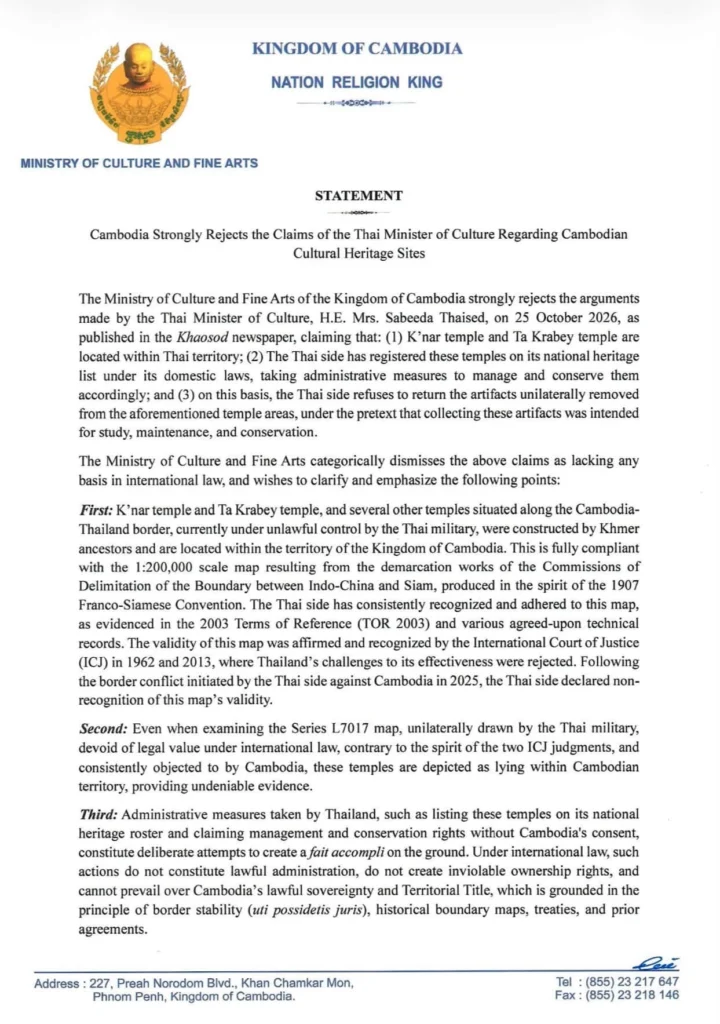
The Ministry of Culture and Fine Arts of the Kingdom of Cambodia categorically rejects the claims made by Thai Minister of Culture Sabeeda Thaised on October 25, 2026, as published in Khaosod newspaper, asserting that: 1. Khnar Temple and Ta Krabei Temple are located on Thai territory; 2. The Thai side has registered these temples in its national heritage list and taken administrative measures to manage, maintain, and conserve them through its domestic laws; and 3. Based on this premise, the Thai side refuses to return artifacts unilaterally removed from the above temple areas under the pretext that collecting artifacts from these temples is for study, preservation, and conservation purposes.
The Ministry of Culture and Fine Arts strongly rejects these unfounded claims that do not conform to international law, and wishes to clarify and emphasize several key points:
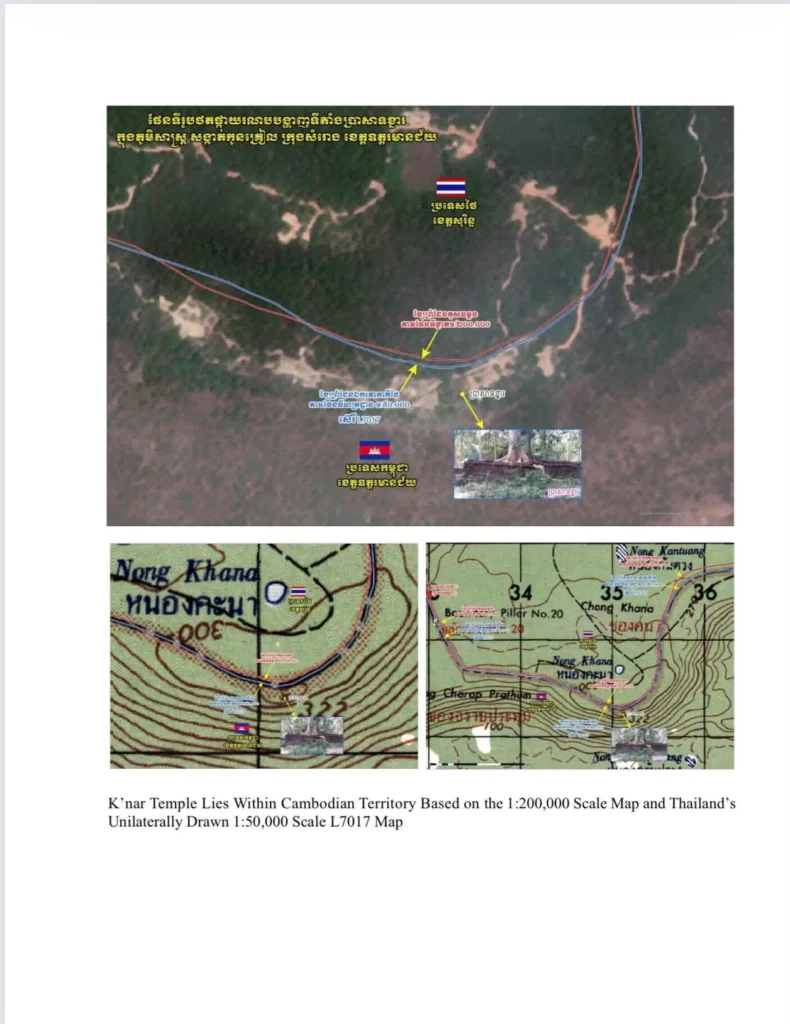
- Khnar Temple, Ta Krabei Temple, and several other temples situated along the Cambodia-Thailand border and currently under the illegal occupation of the Thai military were built by Khmer ancestors and are located within the territory of the Kingdom of Cambodia, in accordance with the 1:200,000 scale map resulting from the demarcation work of the Indochinese-Siamese Boundary Commission established under the spirit of the 1907 Franco-Siamese Convention, which the Thai side has consistently recognized and implemented as evidenced in the 2003 Terms of Reference (TOR) and technical minutes agreed upon in the past. The validity of this map was affirmed and recognized by the International Court of Justice (ICJ) in 1962 and 2013, wherein the Thai side failed in its challenges against the map’s effectiveness. Following the Thai military’s war of aggression against Cambodia along the border in 2025, the Thai side declared non-recognition of this map’s validity.
- Examining the illegal map unilaterally drawn by the Thai military—which holds no legal value under international law, contradicts the spirit of both ICJ judgments, and is consistently protested by the Cambodian side—reveals that even under the illegal L7017 series map, these temples are still mapped inside Cambodian territory. This is undeniable proof by Thailand itself.
- Administrative measures such as registering these temples on Thailand’s heritage list, alongside pretexts regarding the management, conservation, and maintenance of these temples without Cambodia’s consent, are acts intended to create a fait accompli on the ground. According to international law, these actions cannot establish lawful control, cannot generate inviolable rights, and certainly cannot alter Cambodia’s legitimate sovereignty and territorial integrity, in accordance with the principle of uti possidetis juris, historical border maps, treaties, and past agreements.
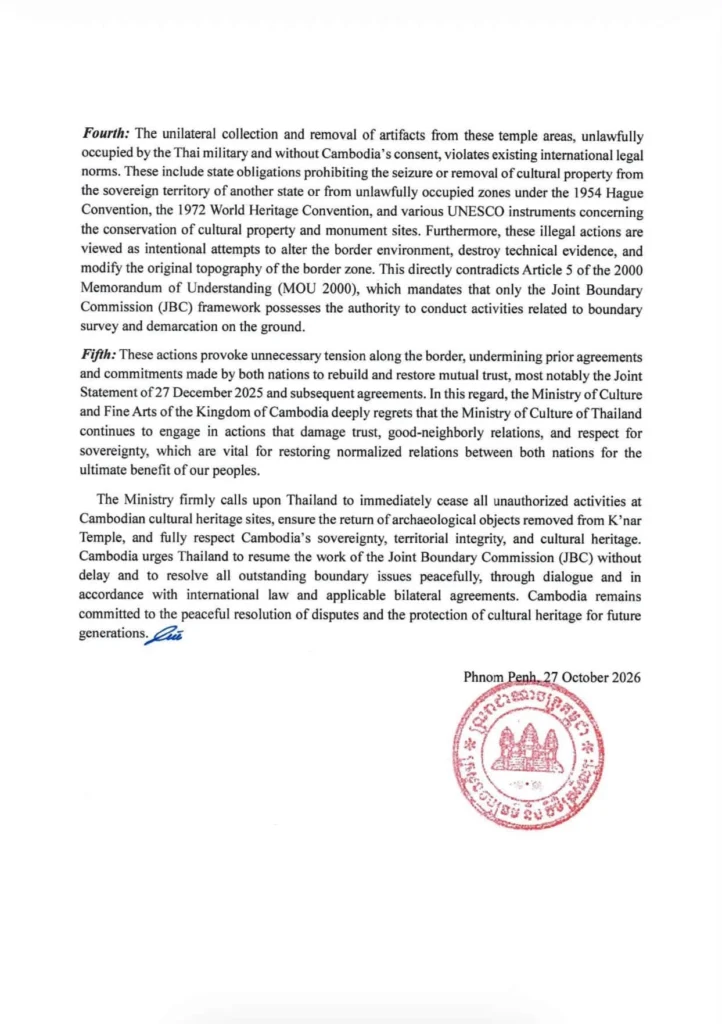
- The removal of artifacts located within temple sites illegally occupied by the Thai military and without Cambodia’s consent constitutes a violation of existing international legal standards, such as the obligations of State Parties prohibiting the removal of cultural property in any form from the territory of a sovereign state or from illegally occupied areas pursuant to the 1954 Hague Convention, the 1972 Convention, and UNESCO legal instruments concerning the conservation of cultural property and temple zones. Furthermore, these illegal acts are considered intentional attempts to alter the border environment, eliminate technical evidence, and distort the original structure of the border region, which is in direct violation of Article 5 of the 2000 MOU. Only the JBC commission mechanism possesses the mandate to conduct activities serving on-the-ground measurement and demarcation.
- These actions are also considered acts that cause border tensions, contradicting the agreements and commitments made by both parties in the past to build and restore trust in accordance with the Joint Communique dated December 27, 2025, and previous bilateral agreements. In this regard, the Ministry of Culture and Fine Arts of Cambodia deeply regrets that the Thai Ministry of Culture has repeatedly provoked incidents that undermine trust, the principles of good neighborliness, and sovereignty, which are essential for restoring bilateral relations for the mutual benefit of both peoples.
The Ministry of Culture and Fine Arts firmly demands that Thailand immediately cease all unauthorized activities at Cambodia’s cultural heritage sites, demands the return of antiquities removed from Khnar Temple, and calls for full respect for Cambodia’s sovereignty, territorial integrity, and cultural heritage. Cambodia urges Thailand to resume the work of the Joint Boundary Commission (JBC) without further delay, resolve all remaining border issues peacefully through dialogue, and adhere to international law and relevant bilateral agreements. Cambodia remains steadfastly committed to peaceful dispute resolution and the protection of cultural heritage to preserve it as a legacy for future generations.